You don't lose to the market.
You lose to yourself.
It can't FOMO. It can't revenge-trade. It can't move its stop to "give it room." You write how you trade. It runs exactly that, on a live map of every stop and liquidation in the market. It hunts that liquidity with the whales, not as their fuel.
Free to run, up to 100 strategy evaluations a day. Non-custodial. You pay 0.02% only when it trades. No email, no API key.
We run it on our own money. Live. Real trades, real fills, real AI reasoning. On /watch, no signup. Don't believe us. Watch.
▶ Watch the live botDescribe your edge in plain English. It runs yours.
Write how you trade, in plain words. The bot runs exactly that. No code. No config.
"Scalp breakouts on momentum." "Only swing longs on 4-hour support." "Stay flat around CPI."
Most bots stare at indicators. This one sees the whole market's stops.
Every stop. Every liquidation level. Every profit wall in the market, mapped live. The bot trades toward that liquidity instead of getting hunted out. It's the order-flow map the pros pay for, pointed the other way.
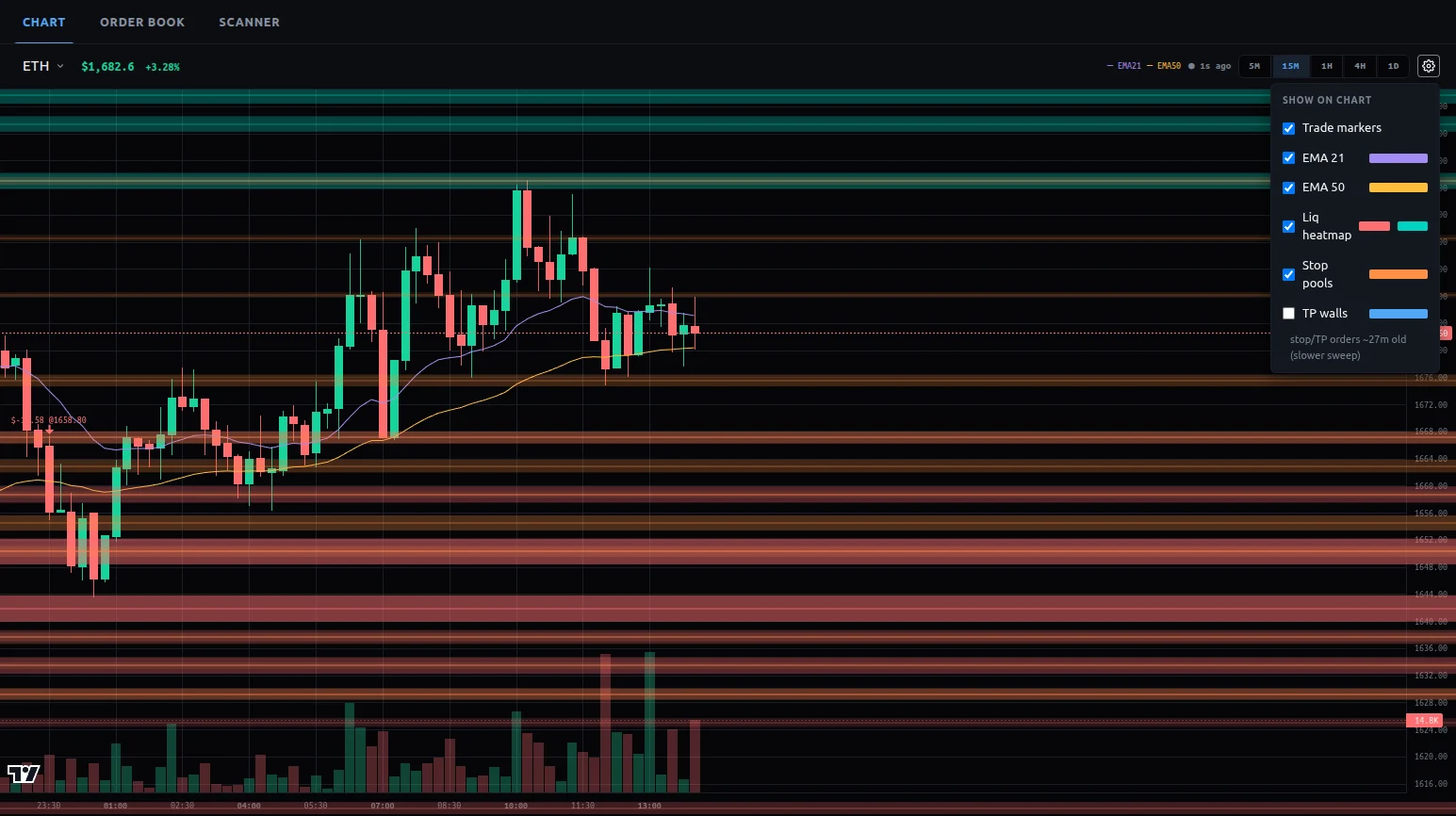
Liquidation clusters
Where forced liquidations pile up. Long pools below price, short pools above. The fuel a move runs toward.
Stop-loss pools
Where resting stops cluster. Read from real order types, not guessed. Stop-hunt territory.
Take-profit walls
Where supply caps a rally and demand catches a dip. Where moves stall.
Whale positioning
Net OI skew, whale-vs-retail split, fresh money, trapped %, crowd leverage. Which way the size is leaning.
It targets the nearest untouched pool, in the market's direction. It chases a bigger cascade only when the volume backs it.
No strategy? It already runs one.
Out of the box it runs liquidity-magnet: it reads that liquidation map and trades with the market's flow, toward the nearest untouched liquidation pool — next to the whales who move price, never as their fuel. It front-runs the near edge by default, and only chases a deeper cascade when the volume backs it. Want something else? Describe your own edge in plain English and it runs that instead.
Your main wallet sets it up once. After that, it's never touched.
The #1 thing people fear about a trading bot is "connect wallet." Here's exactly what happens when you do.
Approve, once
Your wallet approves two things: a dedicated agent wallet that does the trading, and the 0.02% builder fee that keeps the bot free. We never store your main wallet's keys.
→The agent trades
From then on the bot uses only the agent wallet. It can place orders and set stops. Nothing else.
→You stay in control
Funds live in your Hyperliquid account. Revoke the agent in one click on app.hyperliquid.xyz, anytime.
We hold nothing you can lose. Your agent key is encrypted at rest and never leaves our server. The protocol lets it trade and set stops, never withdraw. Your USDC only ever moves to your own wallet.
Start for free. Live in about five minutes.
No code, no extension. Two ways in, pick one. Full 5-minute setup guide →
Recommended. Make a fresh wallet with email or a passkey, then fund it in the app. Nothing to install. You're the only one who holds it.
Create a wallet
Email or passkey makes one via Privy. You approve two things: the agent wallet, then the 0.02% builder fee.
Fund with USDC
Buy with a card through MoonPay, or send USDC on Arbitrum. $50+ recommended.
Bridge to Hyperliquid
One click moves it to your HL perps account. Gas is on us.
Deploy
Keep the default, or write your strategy. Hit deploy. It's live.
Ready to walk through it?
Deploy free →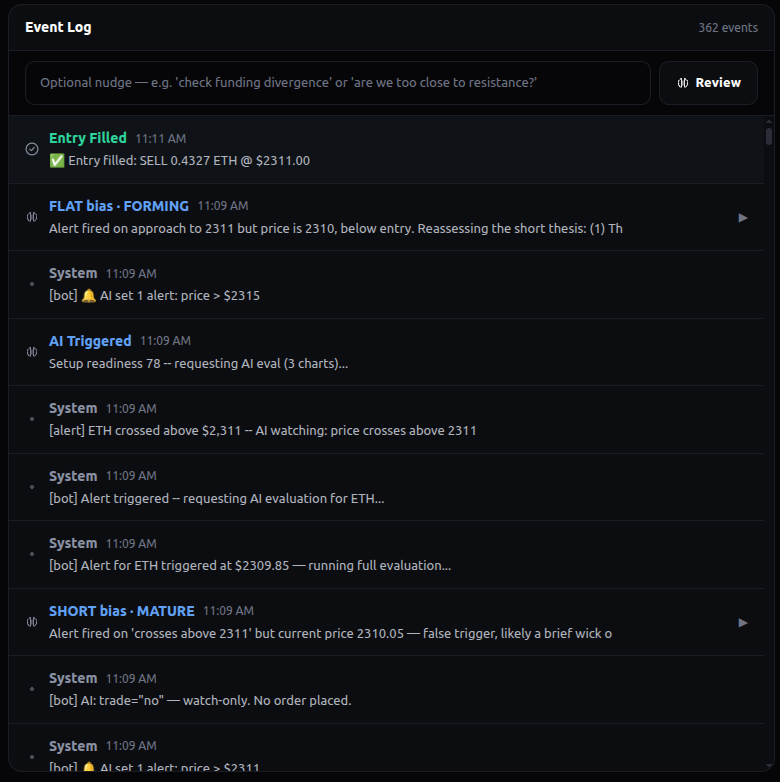
Every trade, with the reasoning that caused it.
Every entry and exit is marked on the chart with its real P&L, and keeps the full AI reasoning behind it. Click any trade to see why.
A trader's journal you didn't have to write. No cherry-picking: drawdowns sit next to the wins.
You can't pay us if it doesn't trade.
No subscription. No setup fee. No performance fee. We earn one thing: a 0.02% builder fee per trade, settled on-chain. What "free" actually means →
- Free AI: up to 100 strategy evaluations a day, no API key
- Liquidity-magnet default + plain-English custom strategy
- Marketwide liquidation heatmap
- Atomic brackets + account-level kill switches
- Full AI reasoning log on every trade
- Mobile + desktop PWA
No subscriptions. No performance fees. No custody. The builder fee is on-chain and verifiable on Hyperliquid.
The discipline is enforced in code, not vibes.
A "confident" AI isn't a safe one. These rails hold no matter what the model thinks, or what you write. Is a Hyperliquid bot safe? →
It's never naked.
Entry and its stop-loss ship as one signed order. There's never a moment where you're in a trade without a stop. The take-profits attach right after, on their own, so a target filling can't cancel your stop.
It can't move its stop. You can. It won't.
The stop sits past the level that proves the trade wrong. Never inside the noise, where it just gets wicked out.
It can't take a trade that fails the math.
Every setup must clear the risk/reward and expectancy gates before an order exists. The AI can't override them. They live in code, not the prompt.
It quits when you'd keep digging.
Hit a daily loss cap or a losing streak and the bot stops trading. A string of "fine" trades is exactly how accounts bleed.
It banks and de-risks.
After the first target fills, the stop moves to breakeven on the rest. Winners get protected. Losers get cut.
None of this promises a winning week. It caps the damage and takes out the tilt. But the AI will still be wrong sometimes, and a run of losses can still draw your account down.
It doesn't sleep. It doesn't clock out.
The setup you've waited for never prints while you're watching. So the bot runs 24/7 in the cloud, not on your laptop. Close the tab, go to sleep. It keeps trading.
24/7, in the cloud
It lives on Cloudflare's edge, not your computer. Close your browser and it keeps trading. Reopen the app and everything from while you were away is waiting.
Your own private instance
Your bot lives in its own private serverless instance on Cloudflare — dedicated storage, not a shared server. Your strategy and keys never mix with anyone else's, and it scales the same from user 1 to user 10,000.
Not a single point of failure
It runs on the same network that serves a big slice of the internet. And if Hyperliquid ever pauses, your stops live on its order book and still fire, whether we're up or not.
Frequently asked questions
What's the actual edge?
Can I program my own strategy?
What does it actually cost?
Is the AI really free?
Can the bot withdraw my money?
How does the bot manage risk?
Can I see it work before I sign up?
Can I lose money?
What happens when I close my browser?
The long version, if you want it.
The details under the hood. Open only what you care about.
How the liquidation map is built
Most "whale tracking" tools watch a handful of hand-picked wallets. We don't. A dedicated data pipeline pulls the entire active Hyperliquid leaderboard, roughly 21,000 accounts, and re-sweeps it about every 10 minutes. It reads each account's positions and resting orders straight from Hyperliquid.
From that it builds four anonymized layers: forced-liquidation clusters, declared stop-loss pools and take-profit walls (read from real order types, not guessed), and whale positioning. Market-maker grid bots are spotted and left out, since their hedged inventory isn't directional.
How the risk engine keeps a confident AI from blowing up
An AI that's sure of itself is not the same as a safe one. So the safety lives outside the model, in code it can't reach. Every entry is placed with its stop-loss in a single signed order; the take-profits attach after as standalone reduce-only orders so a fill can't cancel the stop. The stop is anchored to structure, not a fixed percentage noise can wick. Before any order exists, the setup must pass server-side risk/reward and expectancy checks. Account-level kill switches stop the whole bot after a daily loss cap or a losing streak. Position size is derived from your risk-per-trade and the stop distance.
You can hand the bot an aggressive strategy. You cannot hand it one that removes these rails. Is a Hyperliquid bot safe? →
What "non-custodial" really means here
Non-custodial isn't a marketing word for us. It's the architecture. Your funds sit in your Hyperliquid account. The bot works through Hyperliquid's native agent-wallet system: you give a dedicated agent key permission to sign trades and manage stops, and the protocol flatly forbids that key from withdrawing or transferring funds. The key is encrypted at rest and never leaves our server. The only address your USDC can ever move to is your own. Free Hyperliquid bot options →
New to Hyperliquid? The 60-second version
Hyperliquid is the top on-chain perpetual-futures exchange. It's a fully non-custodial DEX with deep liquidity, sub-second fills, and no KYC. Perps let you go long or short with leverage. "Perpetual" just means there's no expiry. It's where HyperPerps AI trades, because its agent-wallet system is what makes a non-custodial bot possible.
Open an account with our referral for a 4% fee discount, add USDC, and you're ready to deploy. Compare Hyperliquid bots for 2026 →
See the map. Watch it trade. Then decide.
Costs nothing to start. Your funds never leave your account. Watch it run live first.
No email. No credit card. Funds stay in your Hyperliquid account.
New to Hyperliquid?
Hyperliquid is the top on-chain perp futures DEX. Non-custodial, fast, deep liquidity, no KYC. It's where HyperPerps AI trades. Sign up through our referral for a 4% fee discount.
HyperPerps AI is beta software. Perpetual futures are high-risk by design. Leverage grows your losses as fast as your gains. The AI will be wrong sometimes. Some weeks will be drawdowns. We don't guarantee profits, we can't prevent every bug, and past results don't predict future ones.
Trade money you can afford to lose entirely. By using HyperPerps AI you accept full responsibility for all outcomes. We are not a registered broker-dealer and we do not give financial advice. Read the Terms before depositing.